.empatyzer / stories← Back to EmpatyzerPL
25 / 30

Differences that change the conversation

Don’t make a fuss

Speaking up and the cost of belonging

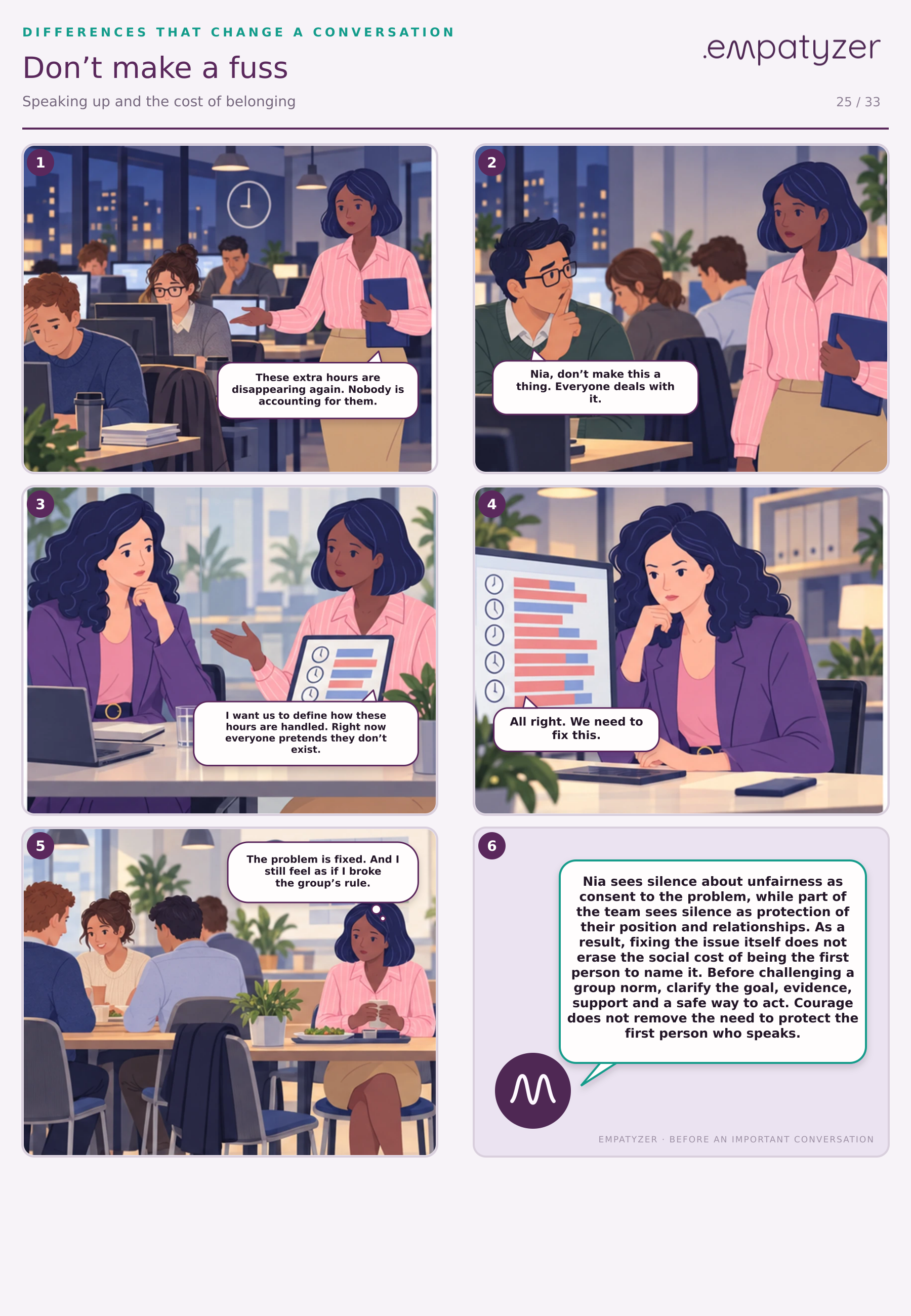
Nia reacts to unfair treatment, but the group asks her not to make a fuss. Speaking up for the right reason can carry a real social cost.
Download the full comicPage ↗PNGSVGPPTX
Nia points out unaccounted overtime while the tired team works late in the office again.
These extra hours are disappearing again. Nobody is accounting for them.

A worried colleague discreetly silences Nia while the others avoid eye contact.
Nia, don’t make this a thing. Everyone deals with it.

Nia presents Zofia with evidence of repeated overtime.
I want us to define how these hours are handled. Right now everyone pretends they don’t exist.

Zofia reviews the hours summary and recognises the scale of the problem.
All right. We need to fix this.
After the issue is resolved, Nia sits apart at lunch while part of the team keeps its distance.
The problem is fixed. And I still feel as if I broke the group’s rule.

Em, the Empatyzer coach
Nia sees silence about unfairness as consent to the problem, while part of the team sees silence as protection of their position and relationships. As a result, fixing the issue itself does not erase the social cost of being the first person to name it. Before challenging a group norm, clarify the goal, evidence, support and a safe way to act. Courage does not remove the need to protect the first person who speaks.