.empatyzer / stories← Back to EmpatyzerPL
34 / 55

Differences that change the conversation

You’re asking again?

Uczenie się a zależność

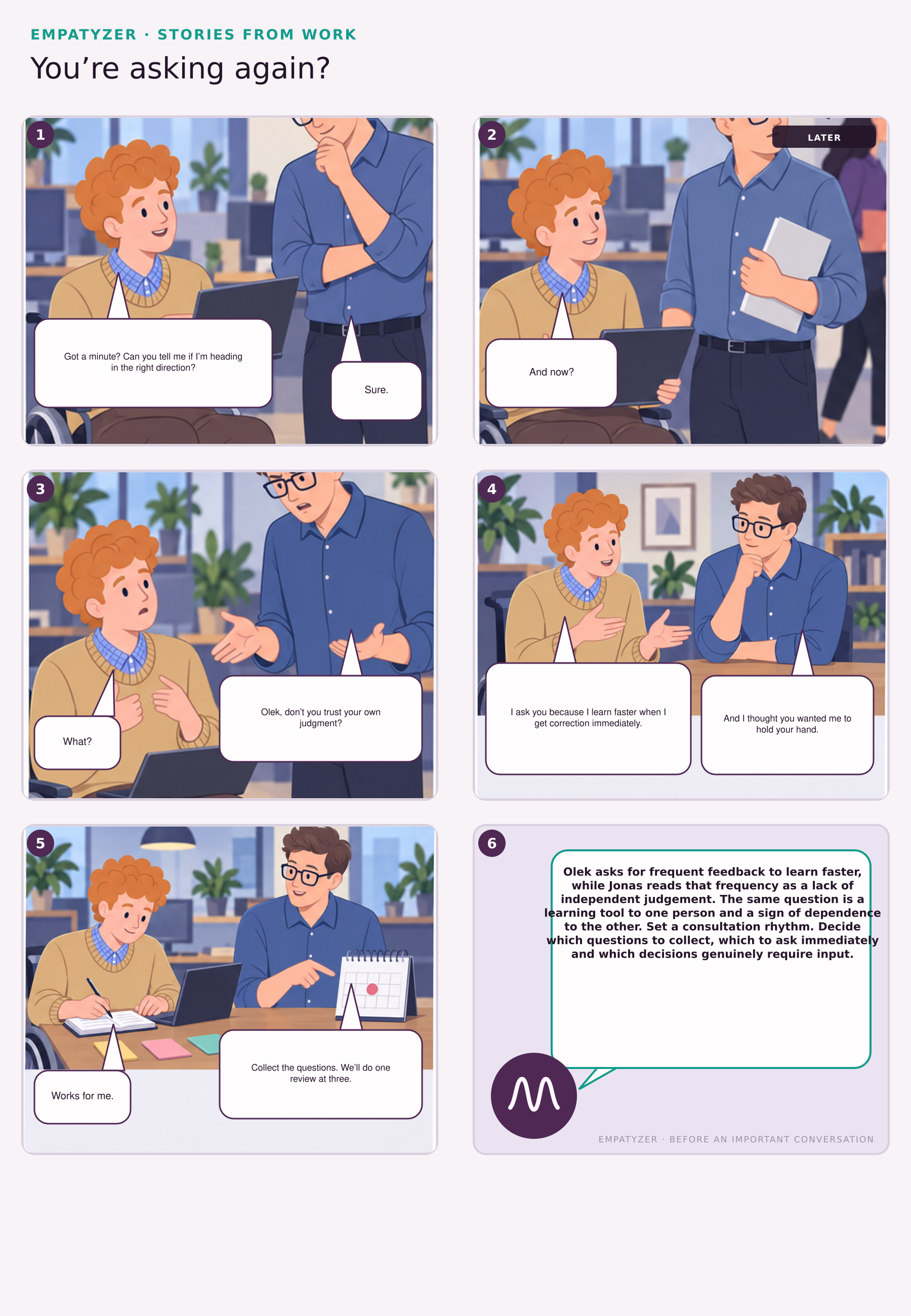
Olek frequently returns to Jonas for feedback. For Olek it is a way to learn; for Jonas it looks like increasing dependence on his judgement.
Download the full comicPNGSVGPPTX
Olek, Jonas in panel 1 of You’re asking again?.
Masz minutę? Powiesz, czy idę w dobrą stronę?Got a minute? Can you tell me if I’m heading in the right direction?
Jasne.Sure.

Olek, Jonas in panel 2 of You’re asking again?.PÓŹNIEJLATER
I teraz?And now?
Olek, Jonas in panel 3 of You’re asking again?.
Olek, nie ufasz własnemu osądowi?Olek, don’t you trust your own judgment?
Co?What?

Olek, Jonas in panel 4 of You’re asking again?.
Pytam ciebie, bo szybciej się uczę, kiedy dostaję korektę od razu.I ask you because I learn faster when I get correction immediately.
A ja myślałem, że chcesz, żebym prowadził cię za rękę.And I thought you wanted me to hold your hand.

Olek, Jonas in panel 5 of You’re asking again?.
Zbieraj pytania. O 15 robimy jeden przegląd.Collect the questions. We’ll do one review at three.
Pasuje.Works for me.

Em, trenerka Empatyzera
Olek często prosi o informację zwrotną, żeby szybciej się uczyć, a Jonas odczytuje tę częstotliwość jako brak samodzielnego osądu. To samo pytanie jest dla jednej osoby narzędziem rozwoju, a dla drugiej sygnałem zależności. Ustal rytm konsultacji. Określ, które pytania zbierać, które zadawać od razu i przy jakich decyzjach opinia jest naprawdę potrzebna.Olek asks for frequent feedback to learn faster, while Jonas reads that frequency as a lack of independent judgement. The same question is a learning tool to one person and a sign of dependence to the other. Set a consultation rhythm. Decide which questions to collect, which to ask immediately and which decisions genuinely require input.