.empatyzer / stories← Back to EmpatyzerPL
26 / 30

Differences that change the conversation

The model isn’t the problem. You are.

Task conflict and relationship conflict

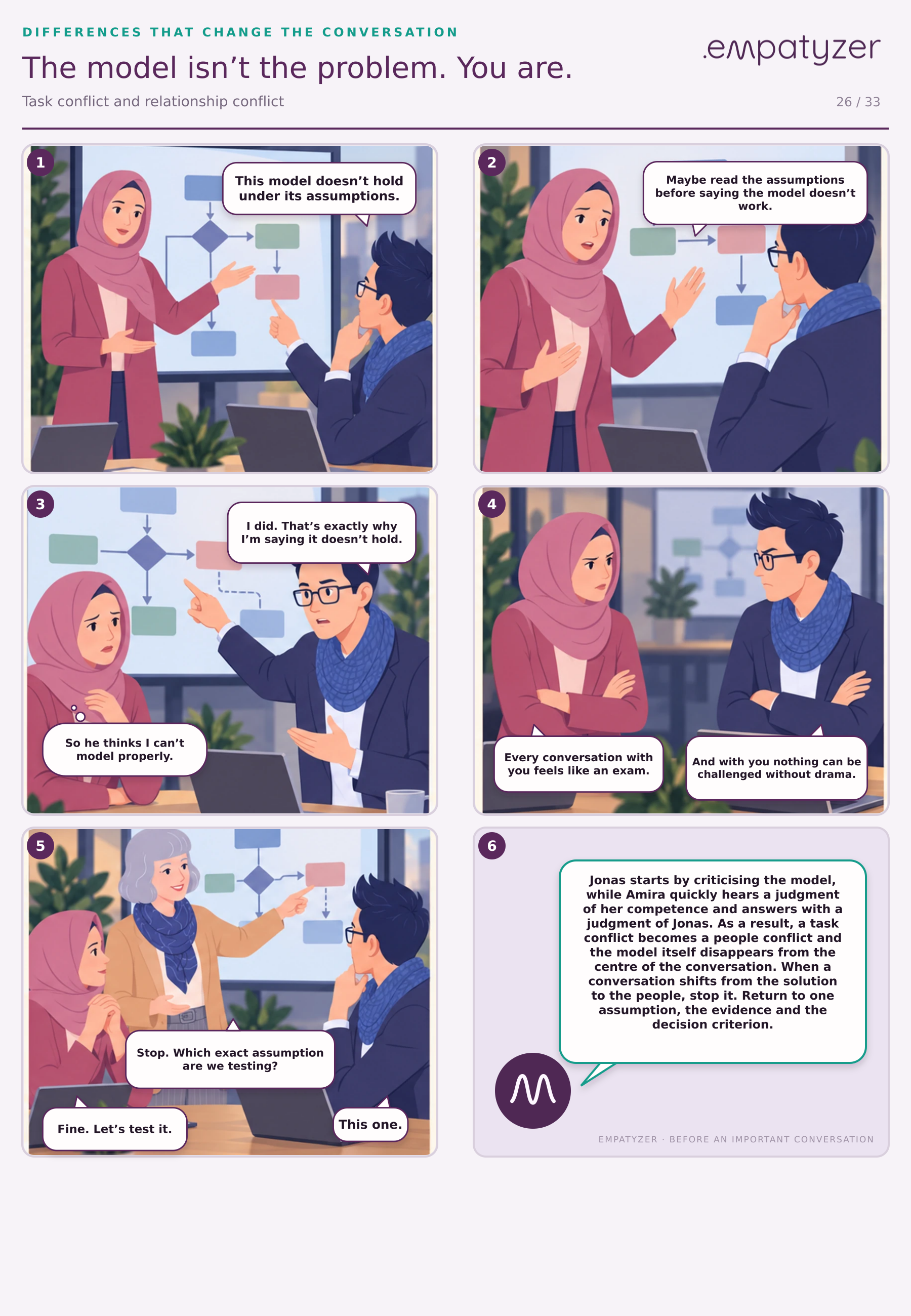
Jonas and Amira begin with a disagreement about a model, then quickly start judging each other. The substantive issue disappears beneath a relationship conflict.
Download the full comicPage ↗PNGSVGPPTX
Amira presents a process model while Jonas points to a connection that he believes does not meet the assumptions.
This model doesn’t hold under its assumptions.

Amira responds defensively to Jonas during their discussion beside the process diagram.
Maybe read the assumptions before saying the model doesn’t work.

Jonas firmly points to a model assumption while Amira hears his criticism as a judgment of her competence.
I did. That’s exactly why I’m saying it doesn’t hold.
So he thinks I can’t model properly.

Amira and Jonas face each other tensely while the process model is left in the background.
Every conversation with you feels like an exam.
And with you nothing can be challenged without drama.

Helena stops the dispute and points to one specific assumption, refocusing Jonas and Amira on the model.
Stop. Which exact assumption are we testing?
This one.
Fine. Let’s test it.

Em, the Empatyzer coach
Jonas starts by criticising the model, while Amira quickly hears a judgment of her competence and answers with a judgment of Jonas. As a result, a task conflict becomes a people conflict and the model itself disappears from the centre of the conversation. When a conversation shifts from the solution to the people, stop it. Return to one assumption, the evidence and the decision criterion.